

Incarnation Is Not Gentle
Company for the longest nights


This Weekly Edition of Inkwell features Annelise Jolley
“STILL GOT IT?” My neighbor called to me from across the street as I passed by on a morning walk. The belly, I assumed he meant. I turned slightly to give him a full profile view, indicating, Yes, still got it.
I was a ripe 40 weeks pregnant. For the past three nights, contractions had seized me for hours, with the first one arriving around midnight. The pain was faint at first, reaching me from far away. As the contraction grew, it pulled me up like a puppet on a string, then yanked me to my knees. I rocked on all fours as the pain crested and washed over me, my head hanging low.
When the tide pulled back, I rolled onto my side and dozed for several minutes. Then another wave built and sped toward me. Hours passed this way. Finally, as the curtains turned gray with the morning, the contractions dissipated. My body quieted, and I slept.

A Google search binge led to a name for my experience: prodromal labor. Also called “false labor,” these nocturnal contractions did nothing to kickstart true labor. It was all of the pain with none of the progress. By the third day, I’d started to dread the approach of evening, staring down another sleepless night that wouldn’t end in birth. I felt exhausted and brittle.
“Your body is preparing for birth,” said well-meaning friends who had experienced the same thing. “The baby will come when she’s ready,” a nurse assured me over the phone. But I was not interested in well-meaning platitudes. I only wanted to be done with these excruciating days of waiting.

IN THE BOOK OF LUKE, two people receive angelic pregnancy announcements. Mary’s annunciation scene is the more famous of the two. When the angel Gabriel tells Mary that she will become pregnant with God’s son, her response is brief: How can this be? Six months earlier, a similar story played out in the temple. Gabriel visits an elderly priest, Zechariah, to tell him that his wife, Elizabeth—who is long past her fertile years—will give birth to a prophet. Zechariah’s response was also brief: How can I know that this will happen?
Here, the scenes diverge, forking into two parallel yet distinct storylines. The two questions are nearly indistinguishable, but Mary’s carries a current of awe while Zechariah’s asks for signs and explanations. Gabriel praises Mary for her belief but tells Zechariah that, because of his doubt, God will whisk words from his lips. For the duration of his wife’s pregnancy, Zechariah waits in silence.

It would be easy to read this as a cosmic slap on the wrist, God punishing Zechariah for not having enough faith—and many theologians have. But the writer Kathleen Norris reads Zechariah’s punishment as grace. “God’s response to Zechariah is to strike him dumb during the entire term of this son’s gestation, giving him a pregnancy of his own,” she writes.
God’s gift to Zechariah is a pregnancy: nine months of quiet anticipation. Maybe new things needed to grow within him, and maybe the soil for this growth was silence. For nine months, he waited and watched his wife’s body swell and listened as Elizabeth and Mary wondered what God was doing through them. When his son is born, Zechariah gives birth to speech. “His name is John,” he writes on a tablet, and immediately words tumble from his mouth again.
IN THE 14th CENTURY, a new artistic tradition emerged in the hills of Tuscany. Italian painters began to imagine Mary not as she was typically depicted, cradling or nursing an infant Jesus, but as visibly pregnant. Images of La Madonna del Parto show Mary in her third-trimester form: her body full, taut, and tender.
The most famous of these pregnant Marys is Piero della Francesca’s fresco in Monterchi. In it, Mary rests one hand on her bloated torso and the other on her hip as though supporting an aching back. The seam of her dress splits open to accommodate her belly—the Renaissance version of leaving one’s jeans unzipped. There’s something that I find comforting about this pregnant Mary. She seems fatigued and restless. She seems, frankly, over it.
But Francesca’s painting can’t fully capture the impatience and chafing discomfort that overtakes a deeply pregnant body. Imagine with me, then, how Mary must have felt in those final weeks. Her joints ache, her fingers are swollen. Painful twinges in her pelvis make her imagine the child’s skull burrowing lower and lower. Her heart patters double time. When she bends to pour water, her vision fractures into a kaleidoscope of light. The sight of her feet is a forgotten dream. The baby squirms and shoves against her ribs, forcing breath from her lungs. Her boy is right there beneath the surface. She senses waves churning within her, a storm gathering force in a far-off ocean.
THE LITURGICAL SEASON of Advent coincides with the final weeks of Mary’s pregnancy. The season also overlaps with the winter solstice, bringing with it the year’s longest nights. “Somebody coming in blackness / like a star,” writes Lucille Clifton in her poem “john.” During Advent, as Mary did, Christians wait in the dark for God to be born. Together we enter into a practice of imagination, aligning ourselves—regardless of gender or child-bearing status—with a young girl who stretched and groaned and ached for light.
There are some Advent seasons when I wait with anticipation and awe. I imagine Mary waiting with the same sense of wonder in her final weeks of pregnancy, as she pressed her palms to her belly and felt her baby push back. Other Advents, I wait in deep discomfort, trapped between my longings and reality. Because the world Mary imagined in her song, the Magnificat—where famished bodies are fed, and cruel leaders are removed from their thrones—is a world for which we are still waiting.
I write this in a world where families risk death by dehydration as they cross the desert just a few miles south of my home, seeking refuge from violence, and where loneliness and isolation have become public health crises. Species from the North Atlantic right whale to the magnolia tree are going extinct because of human greed and unchecked consumption. Cancer kills beloved toddlers, and racist violence claims the lives of beloved children.
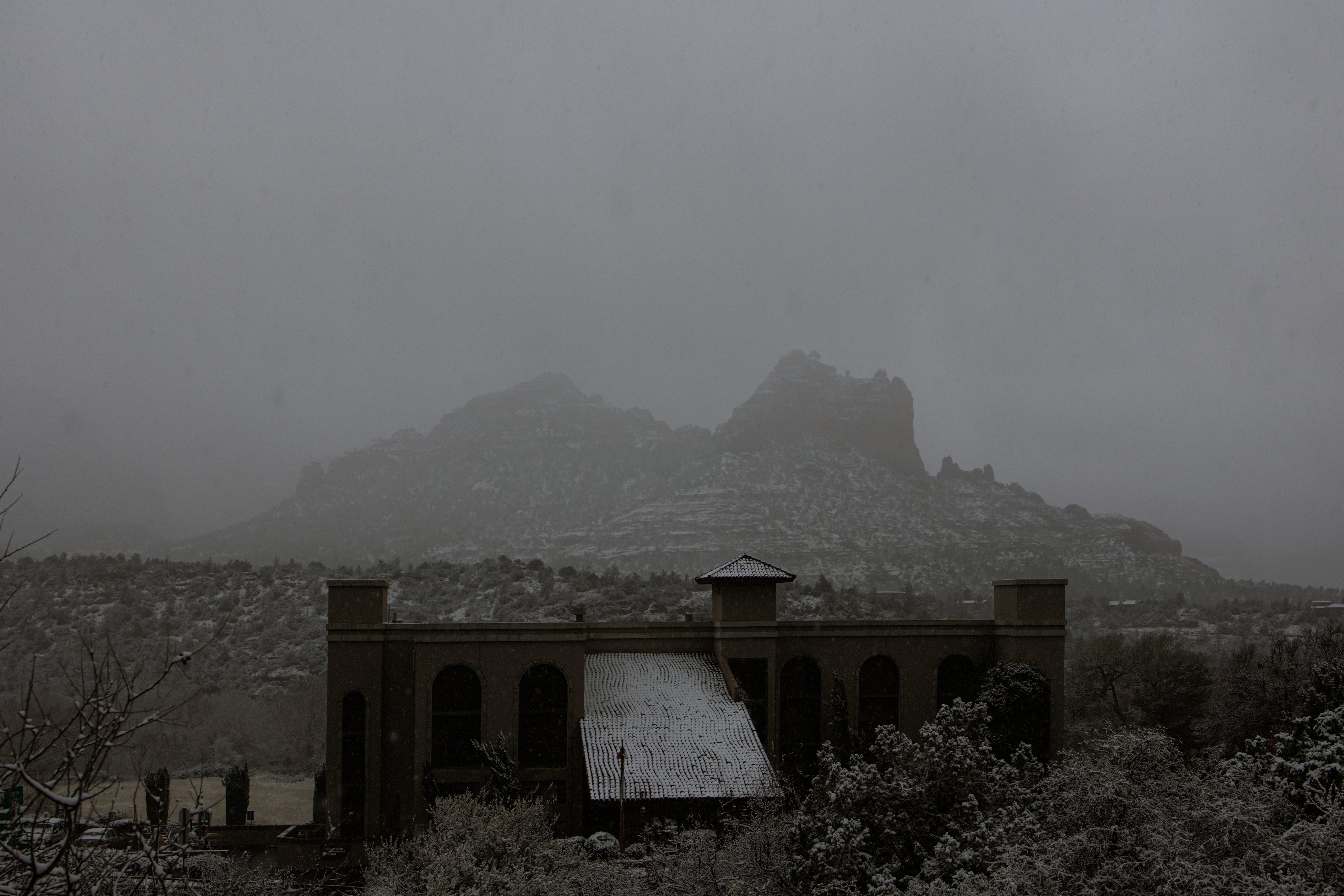
We walk through personal advents too, regardless of the season: our own losses and longings that are often invisible, their precise ache felt only by us. We wait for treatment to work and grief to thaw and doors to open. Sometimes there is no end in sight to our waiting. In these cases, I am wary of calling it a gift.
But if waiting is not always a gift—or at least, not the kind we’d ask for—then maybe it can be a practice. During Advent, the church waits in darkness. Together we enter Zechariah’s silence and Mary’s discomfort. We communally ache and groan. We practice seeing and naming what is wrong. We look directly at sorrow.
So much darkness. But then, a star.
ONLY AT THE VERY END of pregnancy does a body long for labor. No one looks forward to the stretching, squeezing, clenching, and twisting sensations until those final days. It’s only at that point that the alternative—staying pregnant—seems worse.
Writing about late pregnancy’s transformations, the midwife Julie Dotterweich Gunby explains that our bodies ready us in ways that baby showers, hypnobirthing podcasts, and precisely folded onesies cannot. “Where customs and rituals fail, our bodies prepare us for the work of being split in two,” Gunby writes.
Somehow, though this was hard for me to believe in the moment, the discomfort of late pregnancy is a gift too. It prepares one’s spirit and psyche. It readies us to beg for birth. “God has built this grace into the world,” Gunby continues, “that we might come to the point of wanting, calling out for what might devastate us.”
In the last days before birth and the sleepless nights of false labor, I waited for my daughter with desperation. When she arrived, it was as though in a lightning storm: flashes of bright pain, electrical surges, the sense of wind howling around me. Her exit was so quick that the umbilical cord snapped when she left my body.
Later, a midwife noted that my daughter’s cord—her tether to life in the womb—had been unusually short. The midwife hypothesized that the nights of false labor were my body’s way of stretching the cord to protect her so that it didn’t break while she was still in utero. “Your body knew something you didn’t,” the midwife told me. “Maybe your body was waiting until both of you were ready.”
IN SPANISH, dar a luz means “to give birth.” The literal translation for this phrase is “give to light.” I love this linguistic image of giving a child over to the light. But there’s nothing cozy or Thomas Kinkade–esque about the kind of light that we are born into. It’s searing at first. An infant cries and closes her eyes against it.

Likewise, the light we wait for in Advent is hard to look at directly. “Incarnation. It is not tame,” writes Frederick Buechner. “It is unthinkable darkness riven with unbearable light. Agonized laboring led to it, vast upheavals of intergalactic space/time split apart, a wrenching and tearing of the very sinews of reality itself.”
Advent prepares us to bear this light. Just as the final aching weeks of pregnancy prepare a body for birth, our communal aching stretches us, making space to welcome “God with Us.”
In the darkest stretch of the year, it is good to wait together. We need company for our waiting—company through the longest nights.

Annelise Jolley
Journalist & Essayist
Annelise is a writer from California who covers ecology, faith, and motherhood. Her work appears in National Geographic, the Atavist, the Rumpus, Christian Century, Sojourners, Bellingham Review, The Millions, Atmos, and elsewhere. She holds an MFA in creative nonfiction. You can find her on Substack at Read With Me and at annelisejolley.com.
📸 Photography by Elizabeth Sanders
🎄 A Message from Christianity Today: We’ve curated some of the year’s most formative titles on our Holiday Gift Guide for Book Lovers. You’ll find devotionals, children’s Bibles, and books on the Christian life for gifting your friends and family—each thoughtfully chosen to draw readers closer to Christ in 2026.
 | A guest post by
|
Two of my four boys were born in December—I had prodromal labor with all. It felt just as you describe. Beautiful reflections.
This was great, thank you. It seems to me that advent is a time of anticipation that forces us to lament the hopes that have not come to fruition. The work of advent is perhaps to stare into the darkness until our eyes adjust.